

Buffalo Jump Archaeological Site
Updated: March 10, 2026
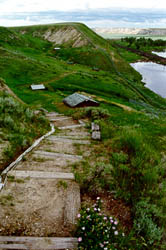
Wahkpa Chu'gn is a prehistoric buffalo jump near Havre, Montana, where Native American hunters used the cliffs to kill bison for more than 2,000 years, and you can still see their bones and tools in the ground today.
Where and What It Is
Wahkpa Chu'gn sits above the Milk River on the west side of Havre, in north-central Montana, close to the Bear Paw Mountains.
It is one of the best-preserved buffalo jumps in the northern Great Plains, with deep layers of bison bones and camp remains still in place.
Archaeologists call it the Too Close for Comfort Site, and it covers about 14.5 acres behind today's Holiday Village Shopping Center along U.S. Route 2.
People Who Used the Jump
Evidence shows Wahkpa Chu'gn was used as a hunting and camping area for over 2,000 years.
Three main cultural groups are represented: the Besant people (about 2,000-1,500 years ago), the Avonlea people, and the Old Women's/Saddle Butte people, who used the site until about 600 years ago.
These groups used the cliffs to stampede bison over the edge, then processed the meat, hides, and bones at camps below the jump.
What You See on a Tour
Visitors can look into excavated pits as deep as about 20 feet and see layers of bison bones, skulls, stone tools, and fire pits left where archaeologists found them.
The site has several wooden viewing shelters and an interpretive center that protect the excavations and display more artifacts from Wahkpa Chu'gn.
Because many items are still in the ground, the experience feels more like walking through an outdoor archaeological dig than a typical museum with glass cases.
Hours, Tours, and Activities
Guided one-hour tours are offered daily from Memorial Day through Labor Day, with most recent listings showing tours between about 9:00 a.m. and early afternoon (often 1:00 p.m. or 3:00-4:00 p.m., depending on the organizer).
Tours are seasonal, and off-season visits may be possible by appointment if the weather is good, usually arranged by calling the H. Earl Clack Museum at 406-265-4000.
At the end of many tours, visitors are invited to try throwing an **atlatl**, a spear-throwing tool used by some of the earliest hunters at the site.
History of Discovery and Protection
John Brumley discovered Wahkpa Chu'gn in 1962 while exploring the bluffs near Havre; local amateur archaeologists soon began the first excavations. [en.wikipedia](https://en.wikipedia.org/wiki/Too_Close_for_Comfort_Site) In the late 1960s and 1970s, the Montana State Archaeological Society and the Milk River Archaeological Society carried out more digs under the H. Earl Clack Museum and Hill County. [en.wikipedia](https://en.wikipedia.org/wiki/Too_Close_for_Comfort_Site) John and Anna Brumley took over day-to-day management in 1992, and the site is now operated as a public archaeological park connected with the H. Earl Clack Memorial Museum. [montanakids](https://montanakids.com/things_to_see_and_do/cool_places/Buffalo_Jump.htm) Also known as the Too Close for Comfort Site, Wahkpa Chu'gn was added to the National Register of Historic Places in 1974 because it is such an important record of Plains hunting cultures.