

A long time ago in Big Sky Country...
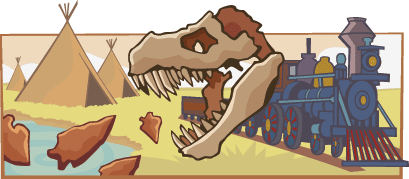
The fascinating history of Montana leads you down many roads. Diverse people, places, and events come together to create the unique state we know today.
Sitting Bull (Tatanka Iyotake)

Tatanka Iyotake, more widely known as Sitting Bull, was a Hunkpapa Lakota leader whose name means “Buffalo Bull Who Sits Down.” He was born around 1831 near the Grand River in what is now South Dakota. As a young man he earned his famous name from his father after showing courage in battle, and he later became a respected spiritual leader and one of the main leaders among the Lakota people.
In 1868, the Fort Laramie Treaty recognized the Black Hills as part of the Great Sioux Reservation and set them aside for the Lakota, who saw this area as sacred. In 1874, however, Lieutenant Colonel George Armstrong Custer led an expedition into the Black Hills and reported the presence of gold. Miners and settlers rushed into the region in violation of the treaty, and Sitting Bull understood that if this continued, his people risked losing their spiritual homeland.
In the spring of 1876, the United States sent more troops to force Lakota and other Plains peoples onto reservations. Sitting Bull called for a Sun Dance, during which he and other warriors fasted, danced, and made sacrifices to the Great Spirit. During this ceremony he had a vision of many soldiers falling into a Lakota camp, a vision his people took as a sign they would win a coming battle. Around this time, Lakota and Northern Cheyenne warriors, including Crazy Horse and others, defeated U.S. troops in a fight at the Rosebud.

Soon afterward, a large Lakota, Northern Cheyenne, and Arapaho village gathered along the Little Bighorn River in what is now Montana. On June 25–26, 1876, Custer and part of the Seventh Cavalry attacked this camp, hoping to force the “non‑treaty” bands onto reservations. Instead, warriors led by men such as Crazy Horse defeated Custer’s command in the Battle of the Little Bighorn, one of the most famous Native victories over U.S. troops. The victory was important but also led the U.S. government to intensify efforts to pursue and control the Lakota.
After the battle, the U.S. Army continued to chase Sitting Bull and his followers. In 1877 he led his people into Canada, seeking safety across the border. Life there was difficult as the buffalo herds declined, and food grew scarce. On July 19, 1881, Sitting Bull surrendered at Fort Buford and was taken into U.S. custody. He and his followers were later sent to agencies such as Standing Rock and did not receive the independent homeland they had hoped for.
Years later, in 1885, Sitting Bull was briefly allowed to travel with Buffalo Bill Cody’s Wild West show. He toured parts of the United States and Canada, meeting performers like sharpshooter Annie Oakley and becoming widely known to audiences far from the Plains. Photographs from this time show his strong, serious expression. Afterward he returned to Standing Rock, where he continued to speak for his people until his death in 1890.